PARLYA Essays · Book 0 · free
Do you write to AI like you would to someone? So do we.
Before the prompt, let’s understand why we talk to AI the way we do.
You write
Hello,
can you help me?
AI responds
Have you ever told an AI “It’s okay”?
You ask the AI to write three lines for a friend’s birthday card, because the card is small. The AI writes eight, all of them very warm. You remind it that you asked for three. It replies right away: “You’re absolutely right, my apologies!” And without even thinking, you type: “It’s okay.”
These apologies look exactly like ours, and for good reason: the AI was trained on vast amounts of text written by people, then tuned by its makers to answer in the role of an assistant. Except that, on the other side of the screen, no one felt embarrassed.
And yet you forgave it.
Only someone can be forgiven.
This reflex is deeply human: when words read like someone’s, people answer as if to someone. Starting with us.
And what if you were the one who was wrong?
This time, you were the one who was right, and your “It’s okay” costs you nothing. But the reflex goes further: between people, we do not lightly admit being wrong, so we believe the person who admits it. Yet AI sometimes backs down when challenged, and tells people they are right when they are wrong.
Apologies from AI read like admissions of fault. They do not prove you were right.
All of PARLYA’s work is reading these moments from both sides: what the machine does, and what we attribute to it. Prompting tips help you ask better, but they do not tell you what an answer is worth. And you ask better when you know what is answering.
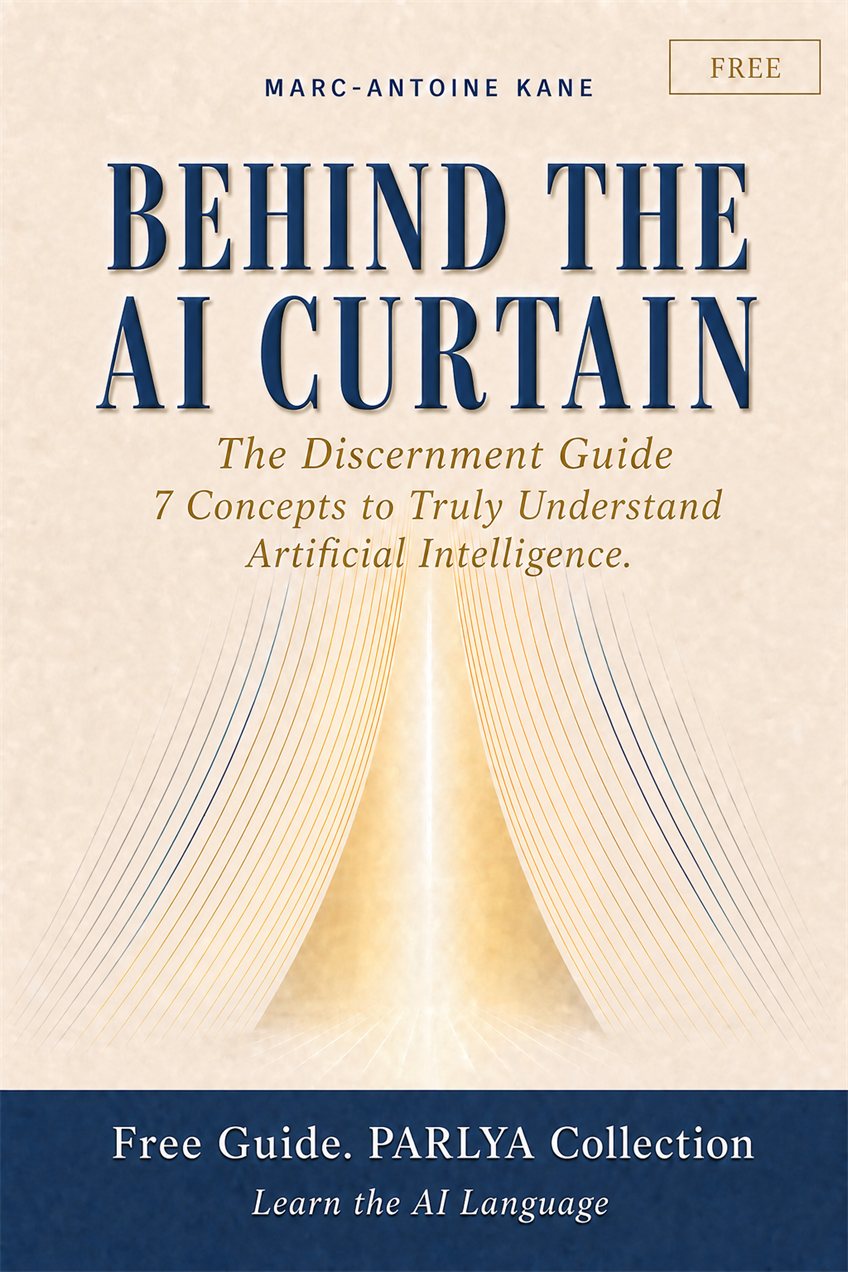
What Book 0 argues
For researchers, alignment is the challenge of getting an AI to act in line with human intentions and values. It is mostly discussed with the most powerful AI systems in mind, but Book 0 shows that the challenge already arises in a simple request.
“The alignment problem does not begin in advanced research laboratories. It begins in every ordinary conversation.”
“It begins when you formulate a request and the AI follows the letter while missing the spirit.”
Download Book 0Free PDF, 1.3 MB, no sign-up
The book arrives at a posture, that of the lucid user. It has three dimensions: lucidity about the mechanism, lucidity about oneself, and lucidity about what AI does not replace, such as being remembered by someone who has known you.
“The lucid user is not suspicious. Not hostile. Informed, and that information changes the quality of their presence in every exchange.”
Marc-Antoine Kane, Book 0, Behind the AI Curtain (PARLYA Essays)
Two other ways to start, free as well
The free course
Understanding AI in seven modules
As you work through the lessons, you read real conversations with an AI, shown in screenshots, with commentary, to see what the machine does and what we attribute to it. The course builds on Book 0. Each module asks you three questions, and every answer comes with an explanation. The course is free. To take it, you create an account on this site.
The PARLYA app
Did You Thank the AI?
The quiz gives you twelve scenes from life with an AI. After a few minutes, your choices sketch a playful portrait of how you relate to AI: what you hand over to it, what you check, and what you attribute to it. It is free, with no sign-up and nothing to install.
AI Transparency Statement
“My position fits in one sentence: I can use AI to work on a text without handing over the thinking that gives the text its direction, its reach and its accountability.”
Marc-Antoine Kane, author of PARLYA
PARLYA
PARLYA is a collection, a method, a course, and an app.
But PARLYA has only one ambition: to help us learn the language of AI so we can finally read our exchanges with it accurately.