Books
PARLYA is building a library to understand what is really at stake in human-AI interaction: not a succession of tools, but a grammar of discernment.
Book 0 opens the collection. The next volumes will deepen the forms of projection, the misunderstandings of reading, delegated uses, and the conditions for a more lucid relationship with artificial intelligence.
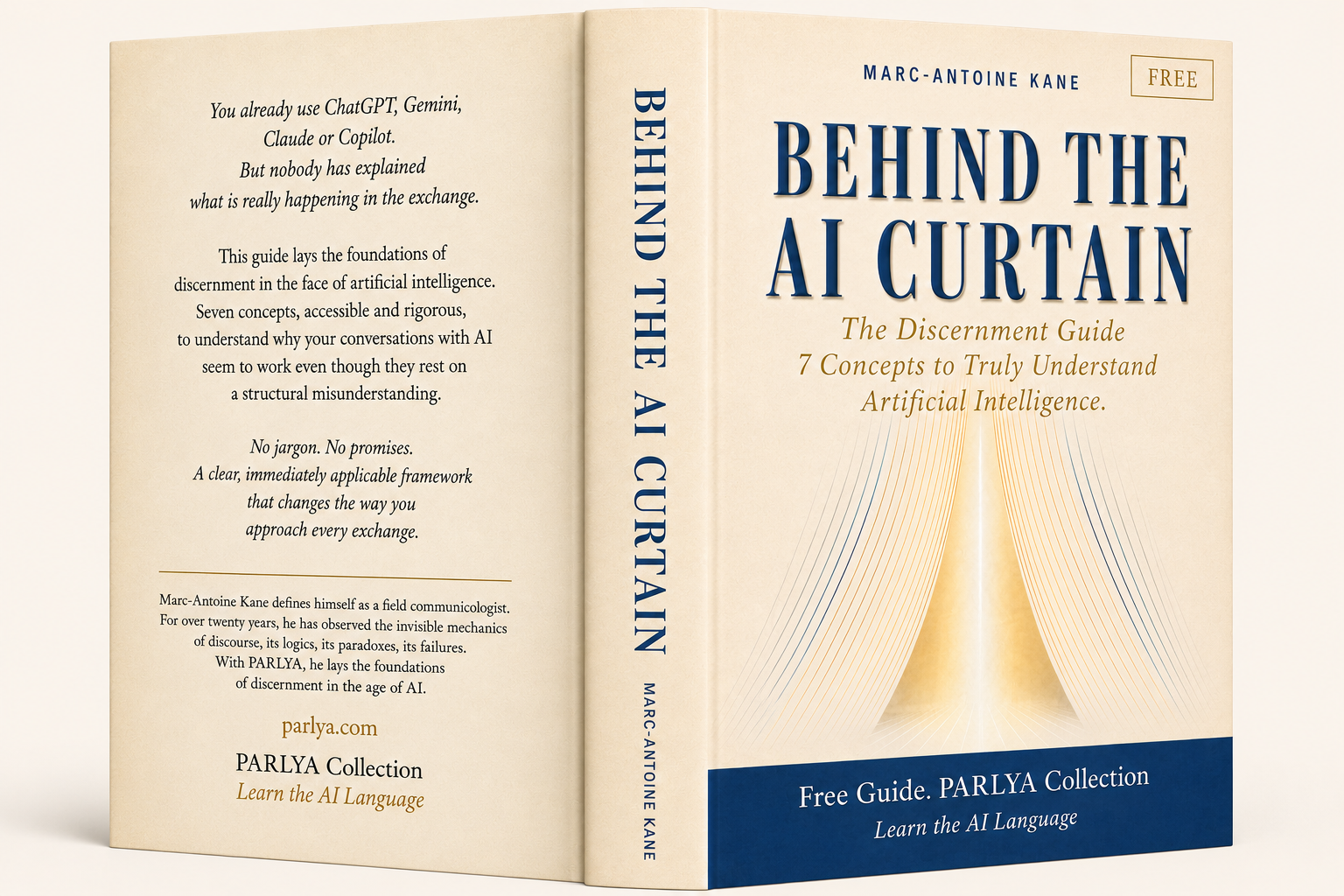
Artificial Intelligence: Behind the Curtain
What you believe you understand about AI probably rests on a misunderstanding. When a response feels fluent, we attribute understanding to it. When it seems well adjusted, we read presence into it. When it reformulates with ease, we assume an intelligence that meets us.
Book 0 offers another reading: understanding what happens in the exchange, distinguishing human projection from actual functioning, and recovering a more accurate position in the face of the language effects produced by machines.
Accessible without jargon, rigorous without simplism, this text lays the conceptual foundations for the whole Parlya project.
Three books and an app to build lasting discernment
The collection does not follow a logic of performance. It builds a reading framework, volume after volume, and then extends it through a companion app oriented toward practice, observation, and stance.
Book 0
The foundations: understanding exchange, projection, and misunderstanding.
Book 1
The recurring patterns of human-AI interaction and their effects on interpretation.
Book 2
Stances, delegated uses, and the limits that need to be rebuilt.
The app
A practical extension to test your discernment and anchor concepts in real use.